
GOING NATIVE - ADOPTED INTO ABORIGINAL FAMILIES
Two boys and a woman saved by Aboriginals

William D’Oyly, John Ireland and Barbara Thompson
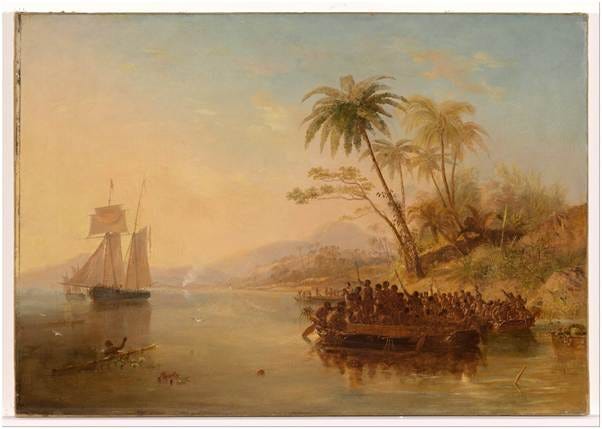
J. W. Carmichael, The Rescue of William D’Oyly, 1841. Oil on canvas, National Gallery of Australia. Photo: Wiki commons.
A FIGHT BACK
Britain’s elite decided the common people were too much trouble, so the elite exported their surplus people to the other side of the world to found a brutal penal colony where they were abused and flogged.
But something surprising happened - the little people did fight back and, bit by bit, they won. Australia still isn’t perfect, but it’s globally respected as one of the best true democracies on the planet, based on ‘a fair go for all’.
How did that happen? Michael’s Curious World (MCW) is travelling the country writing about it. MCW’s real focus in on the little people, the real Aussie battlers who got up every morning and made a difference.
To support this fascinating story click:
‘Subscribe’, choose a free or paid option and enter your details to receive full access to regular posts and the growing archive of past posts. If you can help, it only costs a coffee a month to join the journey and put fuel in my tank.
‘Michael’s Curious World - Posts’ for a menu of the past posts.
‘Like’ to tell the algorithm to spread the word.
These are the stories of three shipwreck survivors who were helped by Aboriginal people.
SURVIVING SHIPWRECKS
THESE are the amazing stories of shipwreck survivors William D’Oyly, John Ireland and Barbara Thompson.
In 1834, whilst sailing from Sydney to India, the barque Charles Eaton was destroyed in rough seas on a reef near the eastern tip of Cape York in northern Australia.
In June 1836, the Government Schooner Isabella arrived at Mer (Murray Island) where Captain Lewis and his crew found two of the survivors, William D’Oyly (aged four) and John Ireland (aged seventeen), living with the Meriam people.
British maritime artist John Wilson Carmichael’s (1799–1868) two paintings, The Rescue of William D’Oyly, by the Isabella, from Murray Island, Torres Strait, 1836 (1839), and The Rescue of William D’Oyly (1841), depict their rescue.
Struggling to recall English, Ireland related his memories of events, including the killing of all the adult survivors and John and William’s adoption into a Meriam family.
The story of the shipwreck and subsequent events is analysed in detail by Lisa Chandler of Sunshine Coast University here. 1 Her focus is on how the paintings reflect a European viewpoint about who is civilised and who are savages, exposing that cultural prejudices appear to have influenced perceptions of the events.
One-sided accounts
We do not have any indigenous accounts, apart from what can be guessed from John Ireland’s story and other accounts, so the European viewpoint dominated publicity about the events, with Carmichael’s paintings giving s story of heroic rescue from captivity.
Eliza Fraser’s claims about surviving savagery may have coloured European attitudes towards indigenous people and affected how the story of William D’Olyly and John Ireland was received by the colonists.

Scholars are re-interpreting early accounts by settlers of their encounters with indigenous people to try to see them through the eyes of the first Australians.
There were several examples of European castaways who survived because of the sustained assistance they received from Indigenous Australians. In 1823, convicts Pamphlett, Parsons and Finegan were aided by First Nations groups in the Moreton Bay region.
Shipwreck survivor Barbara Thompson (see below) lived with the people of Muralug (Prince of Wales Island) for several years from 1844, and castaways James Morrill and Narcisse Pelletier each spent seventeen years living with First Nations peoples in different parts of far north Queensland from 1846 and 1858 respectively.
Fearing attacks
In the Charles Eaton shipwreck, why were all the survivors except the children killed by the islanders?
Historians believe there had been previous encounters with shipwrecks which had persuaded the islanders that the Europeans and their weapons were highly dangerous and must be killed before they could harm the islanders. There are many reports of attacks on indigenous people.
The boys may not have been seen as a threat, so they were adopted by an islander couple, Duppa and Panney, and given the names Waki and Uass.
Accepted into families
William was also looked after by a neighbour called Oby and a strong bond grew up between them, so much so that the child seemed to have quite forgotten his father and mother.
The boys learned the local language and integrated into the daily life of the Meriam people. William played with the other children and Ireland learned important skills. In his testimony, Ireland explained the extensive care he received:
‘My new master, (I should have called him father, for he behaved to me as kindly as he did to his sons) gave me a canoe, about sixty feet long, which he purchased in New Guinea […] He also gave me a piece of ground on which he taught me to grow yams, bananas and cocoa-nuts, […] he taught me to shoot with the bow and arrow, and to spear fish.’ 4
Eventually, following several reports, the Isabella commanded by Captain Lewis was sent from Sydney to seek out any Charles Eaton survivors. On reaching Mer in June 1836, a naked white man was seen amongst the Islanders, who extended their arms to signal peace.
Duppa feared the visitors would kill the white boys and was reluctant to bring them to the ship. However, while the Meriam people traded goods with the ship’s crew. Ireland, 17, negotiated to go on board and for William (now four) to be brought a day later.
The Islanders said William ‘was crying and did not want to leave the women’ and was only persuaded when Captain Lewis ceased all trading and the ship’s guns were shown as a demonstration of force.
Carmichael never visited Australia and, although he tried to be accurate, elements of the paintings reveal a European viewpoint.
For example, his paintings show the boys as white-skinned although accounts from the crew say exposure to the sun had turned their skin a mahogany colour. John Ireland is also shown wearing a white shirt, although both of the boys would have been naked.
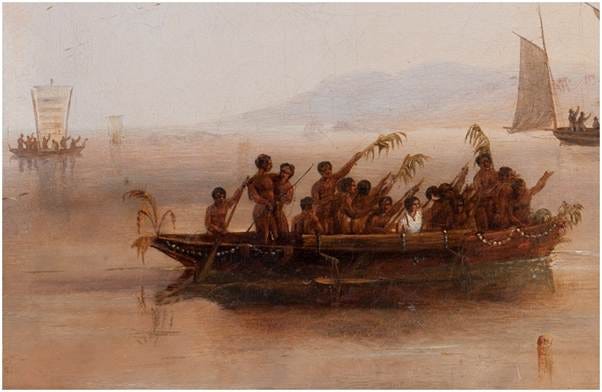
J. W. Carmichael, The Rescue of William D’Oyly, by the Isabella, from Murray Island, Torres Strait, 1836, 1839. Image detail. Silentworld Foundation.
The paintings give an image of benevolent power and triumph over peoples and territory, rather than conveying the deep grief and pain of the boys and their adopted family and friends.
A tearful farewell
Accounts say William seemed frightened, clung to his tearful black friends and pointed back towards the shore, but in the paintings he is shown pointing towards the ship.
Carmichael presented the islanders as enthusiastically participating in the return of William, when in fact the opposite was true. They wanted him to stay with them.
Carmichael used the term ‘rescue’ for his paintings, but Ireland said he was treated with great kindness and owed his life to his adopted parents. Ireland said Duppa ‘cried, hugged me, and then cried again; at last he told me to come back soon’.
By playing down the humanity of the situation, Carmichael emphasised notions of moral superiority of the Europeans compared with the islanders.
More information:
https://www.tandfonline.com/doi/full/10.1080/14434318.2023.2212005#d1e93
John Ireland, The Shipwrecked Orphans: a True Narrative of the Shipwreck and Sufferings of John Ireland and William Doyley, Who Were Wrecked in the Ship Charles Eaton, on an Island in the South Seas (New Haven: S. Babcock, 1845 edition). 36.
Barbara Crawford Thompson
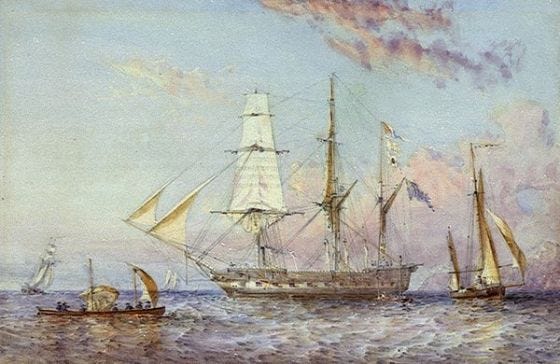
HMS Rattlesnake, which rescued Barbara Thompson, by Oswald Walters Brierly. By Oswald Walters Brierly -http://www.nmm.ac.uk/servlet/ThumbnailServlet?, Public Domain, https://commons.wikimedia.org/w/index
Barbara Crawford Thompson (c. 1831–1912) was a Scottish woman who, as a teenage girl, survived a shipwreck in the Torres Strait and spent five years living with the local Kaurareg people.
She was possibly the sole survivor of the November 1844 wreck of the cutter America, which ran onto Madjii Reef at Horn Island near Cape York.
At the time of the shipwreck, Barbara Crawford Thompson had lived for twenty months in Brisbane with her lover Captain William Thompson as his de facto wife. The cutter America left Morton Bay to salvage whale oil from the wreck of a whaler lost on the Bampton Shoal.
Thompson is presumed to have died while trying to swim ashore after his cutter was wrecked on a reef. Barbara survived and was rescued by islanders
She was taken in by one of the clan leaders (buwai gizumabaigalai) who believed that Barbara was the returned spirit (markai) of his recently deceased daughter.
Barbara lived on Prince of Wales Island (Muralug) for five years and was called "Gioma" or "Giom" by her adopted family.
Leaving the area
On October 16, 1849, Barbara/Gioma managed to make contact with the British survey ship HMS Rattlesnake at Evans Bay and left with the ship. The Rattlesnake's artist, Oswald Brierly, made detailed notes of her stay with the Kaurareg.
Rattlesnake moored back in Sydney in February 1850, and Thompson was reunited with her family.
Little is known about her later life. It is believed she remarried at least once and died in 1912.
Thompson's story is fictionalised in the 1947 book Isles of Despair by Ion Idriss.
Discussion
What do the experiences of these shipwreck survivors tell us about the relationships between colonists and indigenous Australians?
How might our understanding of these encounters have been affected by the lack of indigenous accounts, meaning that we only have one-sided reports?
Have the misunderstandings between peoples from very different societies affected modern Australian society?