
GOING NATIVE - WILLIAM BUCKLEY, ELIZA FRASER
William loves it, but Eliza Fraser hates native life

William Buckley
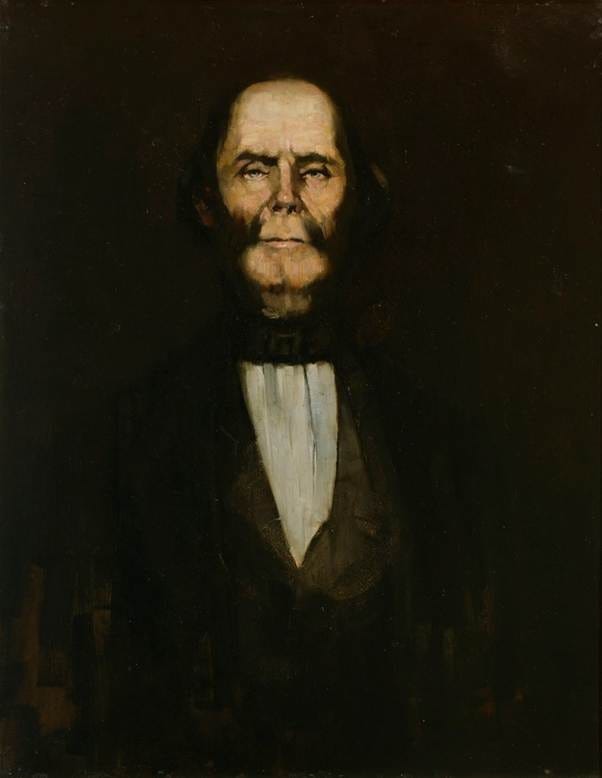
Portrait of convict William Buckley, oil on canvas, 88.7 x 68.4 cm. By Unknown author - State Library of Victoria, Public Domain, https://commons.wikimedia.org/w/index.php?curid=38174404.
How did the convict penal colony of Australia become one of the world’s best true democracies?
Click ‘Subscribe’, choose a free or paid subscription option and enter your details for full access.
Click ‘Michael’s Curious World' - Posts’ for a menu of past posts in the archive.
Only costs a cup of coffee a month.
WILLIAM Buckley (born 1776–1780 – died January 30, 1856), was also known as the ‘wild white man’.
Buckley, who was 198cm tall, became a bricklayer and served in the Cheshire military, fought against Napoleon in the Netherlands in 1799 and was wounded in the right hand.
In 1802 he was convicted of theft, probably unfairly, and transported to Australia for 14 years. He never saw his family again.
Buckley left England in April 1803 aboard HMS Calcutta, one of two ships sent to Port Phillip to form a new settlement under Lieutenant-Colonel David Collins. They arrived at the eastern side of Port Phillip Bay in October, 1803, and landed at Sullivan Bay near what is now Sorrento, where he helped construct buildings.
The new settlement lacked fresh water and arable soil, and a decision was made a couple of months later to abandon the site and move to Tasmania. Buckley and five others escaped during a rain storm on December 27, 1803, hoping to reach Port Jackson (Sydney).
The others were captured, surrendered or separated and Buckley was given up for dead, but he wandered in the Airey’s Inlet area, built a hut and survived on berries, other plants and seafood.
Buckley met three spear-carrying Wathaurong people, who befriended him at a place called Nooraki (Mount Defiance Lookout, now Wye River, Great Ocean Road).
His visitors made Buckley a meal of crayfish and invited him to their huts that night. In the morning the trio went on further into the woods, but Buckley remained in the area and then moved on.
He was finding it hard to get food as winter began, fell into a river, and was feeble when found by two women who brought in their husbands to help him. They were from the Wallarranga tribe of the Wathaurong nation and he lived with them for 32 years, being given the name Murrangurk.
Buckley was cared for, given food specifically selected and prepared to strengthen him and taken in by the former chief's brother, sister-in-law, and nephew. He was adopted into the tribe about one year after he had escaped.
The Wallarranga tribe taught him their language, customs, and bush skills. He learnt to catch fish and eels, cook in their manner, skin possums and kangaroo, and make thread from animal sinew.
The tribe appeared to hunt and gather sufficient food and lived long lives. Buckley often shared his campfire with tribal members and told stories of life in England, on ships, and at war.
They lived on the Bellarine Peninsula of southern Victoria near the mouth of Bream Creek (now Thompsons Creek, and also two kilometres east at the mouth of the Barwin River.
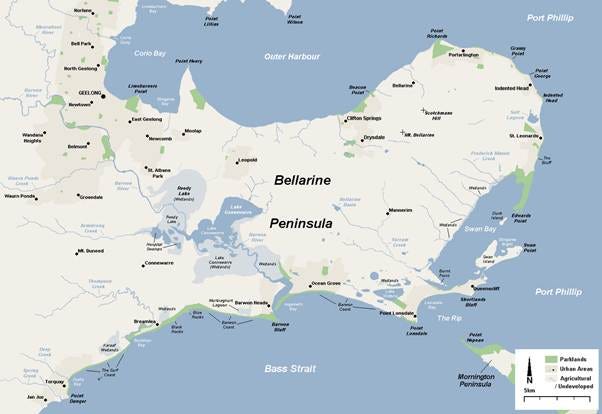
Bellarine Peninsula map. Breamlea and the Barwon area is on southwest coast of the peninsula. By Nick Carson at English Wikipedia - Own work, Public Domain, https://commons.wikimedia.org/w/index.php?curid=17960664
He had access to fresh water, yam daisy, beam seafood, and birds, kangaroo, wombat, koala, wallaby and turkey hunted on the basalt plains. There were several shipwrecks along the coast in which no one survived.
Buckley and other tribal members collected tools, blankets, and other items. A Buninyoung woman, Purranmurnin Tallarwurnin, was 15 years old when she met Buckley and became his wife. They had a daughter.
Buckley became an expert with indigenous weapons and a person of respect in the tribe. When the family who had taken him in were killed in a tribal conflict, he lived alone for a time, later joined by others, and built a weir to catch fish.
He forgot the English language and his hair grew long. As an escaped convict, he avoided meeting Europeans who settled in the area.
In July, 1835, a ship arrived at Indented Head and Buckley learnt that some of the Aboriginal people intended to murder the English passengers and rob the ship.
On July 6, 1835, Buckley and a party of indigenous people appeared at the camp site of John Batman’s Port Phillip Association, led by John Wedge. He wore kangaroo skins, carried Aboriginal weapons, and wore a tattoo with the initials 'W.B.' and tattoo marks.
William Todd wrote this entry in his journal: ‘About 2 o'C. a White Man came walking up to the Native huts, a most surprising hight [sic], Clad the same as the Natives. He seemed highly pleased to see us. We brought him a piece of bread, which he eat very heartily, & told us immedeatily [sic] what it was. He also informes us that he has been above 20 years in the Country, during which time he has been with the Natives....He then told us his name was William Buckley....being so long with the natives he has nearly forgot the English language – but the native languages he can speak fluently.’
The tattoo of initials proved he was the convict William Buckley, who had been given up for dead three decades ago. Legally, he was still a convict and could be imprisoned again.
Buckley convinced the Indigenous people not to attack the Englishmen, and he promised to reward them if they remained peaceful.
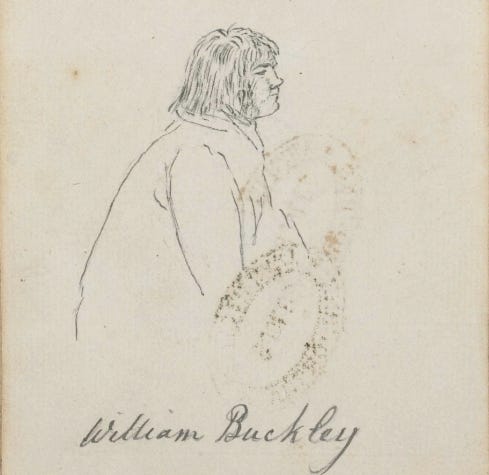
Sketch of William Buckley by John Helder Wedge 1793-1872. - Field book 1835-1836. [manuscript]. http://search.slv.vic.gov.au/permalink/f/1cl35st/SLV_VOYAGER1638007 MS 10768. State Library Victoria (Australia)., Public Domain, https://commons.wikimedia.org/w/index.php?curid=95814776
Wedge obtained a pardon for Buckley through Lieutenant-Governor George Arthur. Buckley became an Indigenous culture recorder and interpreter, who tried to promote peaceful relations between the colonists and natives.
From 1837 to 1850 Buckley lived in Tasmania and worked as a storekeeper at the Immigrants Home and then as a gatekeeper at the Cascades Female Factory.
He married Julia Higgins at St John's Church, New Town, Hobart, on June 27, 1840, and they lived in the Battery Point area of Hobart, where he retired in 1850.
He was seriously injured when thrown from his gig, died of his injuries on January 30, 1856 at the age of 76, and was buried at St. George’s Anglican Church, Battery Point.
Buckley’s remarkable life is best-known for the expression, ‘You’ve got Buckley’s chance’, meaning no chance – it’s impossible.
Buckley’s embrace of native life was totally opposite to the response of shipwreck survivor Eliza Fraser.
Eliza Fraser
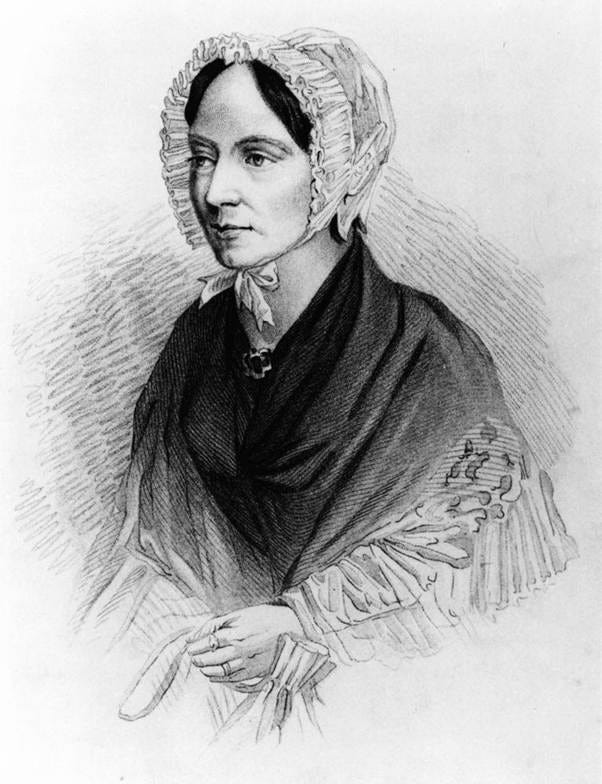
Portrait sketch of Eliza Fraser. By Unknown author - Public Domain https://commons.wikimedia.org/w/index.
Infamous 1833 shipwreck survivor, Eliza Fraser told exaggerated accounts of her experiences on the island now called K’Gari (previously Fraser Island).
Eliza certainly had a tough time, being shipwrecked, surviving an open boat journey, seeing her husband speared to death, being stripped of clothing and relegated to sitting with the tribal women.
None of that would have been anything but traumatic. However, it was Eliza’s behaviour after returning to British society which has made her infamous.
Eliza Slack married James Fraser, a mariner and in 1835, leaving their 14-year-old daughter and two sons in the care of the Presbyterian minister at Stromness in the Orkney Islands, she accompanied her ailing, 56-year-old husband, captain of the brig Stirling Castle, to Australia.
On the night of May 21, 1836 the vessel hit a coral reef and foundered off the north-eastern coast of Queensland. Taking to the lifeboats, the survivors headed south, hoping to reach the convict settlement at Moreton Bay (Brisbane).
A few days after leaving the wreck, Eliza gave birth to a baby, who died. The two lifeboats lost contact; the faster, mistakenly by-passing Moreton Bay, came ashore at the Tweed River; six seamen died and a survivor was rescued at the Macleay.
Meanwhile, the leaking longboat reached the northern tip of Great Sandy Island—later to be renamed after Captain Fraser. Trading goods with local Aborigines for fish, the castaways repaired the boat.
When six seamen defiantly took guns, however, and set off to walk south along the beach, the Frasers and four others were obliged to follow.
Along the way Aborigines stripped the party of clothes, blankets and possessions. At the southern tip of the island a strait barred their way. The Aborigines divided the men among family groups to assist with hunting, fishing and gathering firewood.
Aboriginal women cleansed Eliza's sunburned body with sand, rubbed it with charcoal and grease and decorated it with colour and feathers. She was required to nurse their children, dig fern roots and rob bees' nests, but was so inept and resentful that the women tormented her.
Fraser claimed to have been a captive who was mistreated, when actually the tribe had rescued her and put her in a place of safety with the other women.
She witnessed the death of her husband, after he was speared. His first mate also died and two seamen drowned attempting to swim the strait. Fed on scraps and taken by canoe to the mainland, but not permitted to contact the other castaways, Eliza felt herself a slave.
Three crewmen crossed to the mainland and moved south with Aboriginal groups until, at Bribie Island, they encountered Lieutenant Charles Otter of the Moreton Bay garrison.
Commandant Foster Fyans organized a rescue party of volunteer soldiers and convicts, led by Otter and guided by a convict absconder John Graham. Graham rescued two Stirling Castle seamen from the western shore of Lake Cooroibah (near Noosa).
From a camp at Double Island Point he went north to Fraser Island and returned the next day with the second mate John Baxter. Graham then located Mrs Fraser near the northern end of Lake Cootharaba.
Assisted by his Aboriginal 'relatives', he took her to the beach to meet Otter and his soldiers. The rescue party returned to Brisbane on August 21, 1836.
The survivors recovered from their ordeal at Moreton Bay and then returned to Sydney, where newspapers published exaggerated accounts of their experiences. Fraser falsely claimed to have been assaulted by a white man who wasn’t even there.
Her accusations did great harm to the indigenous residents, who were driven off the island. The Butchulla story of Eliza Fraser’s experiences has recently been told and debunks many of her claims.
Eliza stayed at the home of the colonial secretary, was feted in Sydney society and received a large sum of money (reportedly 400 pounds), raised by public subscription. She married Captain Alexander John Greene on February 3, 1837, and they sailed in his ship, the Mediterranean Packet, for Liverpool.
To the authorities there and in London, Eliza pretended to be a penniless widow. The lord mayor of London held a public inquiry and opened an appeal.
After it was revealed that she had remarried and had already received recompense, the lord mayor's fund was mostly allocated to the Fraser children, and Greene took Eliza back to Stromness to be reunited with them.
Eliza Fraser, Narrative of the Capture, Sufferings, and Miraculous Escape of Mrs Eliza Fraser (New York: Charles S. Webb, 1837).
K’gari: The Real Story of a True Fake, written by Fiona Foley and Larissa Behrendt, directed by Boris Etingof, Studio Breeder and SBS Online Documentary and SBS Digital Creative Labs.
· https://adb.anu.edu.au/biography/fraser-eliza-anne-12929
Discussion:
Why did William Buckley not only survive, but live successfully with the Aboriginal people for so long?
Why were Eliza Fraser’s experiences on the island so unhappy?
How do the attitudes of William and Eliza towards the Aboriginal people compare and contrast?
Why was the behaviour of William and Eliza once they returned to colonial society so different?
Two remarkable stories here.
William Buckley was saved by an Aboriginal tribe near Melbourne and went fully native.
Eliza Fraser was taken in by a tribe on K'Gari north Brisbane, hated it and exploited her ordeal after being rescued.
Two cultures clashed, with wildly differing results.