
CHARLES STURT - THE DESPERATE SEARCH FOR THE GREAT INLAND SEA
The water was under their feet all the time.

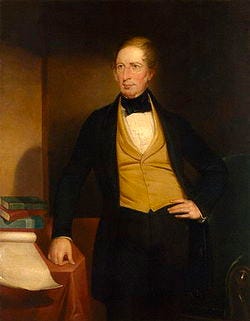
Charles Sturt, by John Michael Crossland (died 1858), given to the National Portrait Gallery, London in 1946. See source website for additional information.
How did the convict penal colony of Australia become one of the world’s best true democracies?
Click ‘Subscribe’, choose a free or paid subscription option and enter your details for full access.
Click ‘Michael’s Curious World’ - Posts’ for a menu of past posts in the archive.
Only costs a cup of coffee a month.
CHARLES NAPIER STURT (April 23, 1795- June 1, 1869)
‘I had done all that man could have done to break through this terrible desert.’ Charles Sturt. 1
CHARLES Sturt was in a desperate situation in late 1845, his starving party trapped at the one reliable waterhole they could find near Milparinka, surrounded by dry creeks, stony desert and undrinkable salt lakes.
Sturt had led five sorties to the north trying to find enough water so the thirsty party of 15 men, horses, bullocks dragging drays and a flock of sheep could move on, but the little muddy slush they could find was so salty it was undrinkable.
What’s more, they couldn’t retreat either as the waterholes which had sustained their progress had dried up, cutting off their retreat to the Darling River, the last reliable water source.
No rain had fallen and every day they scanned the skies desperately hoping for clouds to appear, but none did. Meanwhile, the water levels in the waterholes which were life or death to them were steadily falling, day by day. It was a race against time. Would the waters last until the rains finally came?
They were trapped indefinitely, increasingly becoming sick with scurvy caused by a lack of fresh vegetables.
Sturt, a religious man, feared he was being punished by God for his sins by being abandoned to die in the desert, and fought to reconcile his faith in God with his apparently hopeless situation.
Finally forced to admit defeat and turn back in 1844 Sturt, thinking his expedition a failure, wrote:
‘I had done all that man could have done to break through this terrible desert. I had now been exposed for 12 weeks to every change of temperature I had been subsisting on 5 pounds (2kg) of flour a week if I excerpt a few birds as we occasionally shot. I had ridden more 1600 miles and worn out all the men who formerly attended me and had been obliged to take others in their place. I could do no more, yet I turned from that dreary region with regret. My strength and my sight I felt were fast going. Under such circumstances, I determined on returning to the Depot, satisfied that no exertion of mine would enable me to cross the heartless desert in which I was.’ 1
How did this situation come to be?
Charles Sturt led three important expeditions into central Australia, proved the eastern rivers flowed into the Murray, brought cattle from Sydney to Adelaide and served as an Army Captain and colonial official.
His biggest disappointment was that his final expedition was unable to reach the centre of the continent, but he did demonstrate that Cooper Creek provided enough waterholes even in droughts to allow graziers to move their herds into the inland.
Stuart was unable to find the elusive ‘great inland sea’ which he and others believed must be fed by rivers flowing westwards from the coastal ranges. He watched the birds flying north and speculated they must be flying to water and food, but where was it?
Actually, there had once been the Eromanga Sea covering much of Central Australia, which had dried up by about 50 million years before. The water was still there under Stuart’s feet as the enormous Great Artesian Basin under central Australia, but Sturt couldn’t have known that.
Sturt was regarded with great affection and loyalty by his men, who followed him almost to their deaths. He unfailingly treated the Aborigines well, following the example of explorer and protector Edward Eyre, and had friendly relations with the tribes, unlike some others, including Sir Thomas Mitchell.
Sturt repeatedly suffered severe scurvy from a lack of vegetables containing Vitamin C during his expeditions, which ruined his eyesight and almost killed him.
Not being from a wealthy family, Sturt was disadvantaged in political affairs and should have received greater credit for his achievements from the authorities in London.
Sturt left a rich legacy of journals of his expeditions and letters to his wife Charlotte and there are also other accounts by members of his exploring parties. Several books have been written about him. I particularly recommend: Ivan Rudolph, ‘Sturt’s Desert Drama’, 2013, Boolarong Press, Salisbury, Brisbane, Australia, for its intricately-detailed drawing upon the original sources to bring to life the reality of the desperate struggle for survival in the harsh desert during Sturt’s final expedition. It is a gripping story.
Sturt’s life journey began in Bengal, India, where his father was a judge. He was educated in England, but his father could not afford to send him to Cambridge University, so he was placed in the Army, the 39th Dorsetshire Regiment. He saw action with the Duke of Wellington in the Peninsular War and against the Americans in Canada, returned to Europe and was gazetted lieutenant in 1823 and captain in 1825.
With a detachment from his regiment, Sturt escorted convicts aboard the Mariner, arriving in Sydney on May 23, 1827. Sturt liked life in the colony and the Governor of New South Wales, Sir Ralph Darling, promoted him. He became friendly with explorers including John Oxley, Alan Cunningham and Hamilton Hume.
Governor Darling approved Sturt’s plan to explore the Macquarie River in western New South Wales and he left on November 10, 1828, with his servant Joseph Harris, three soldiers and eight convicts, later joined by the experienced Hamilton Hume as first assistant.
There was a severe drought in 1828-29 which made it difficult to find sufficient water, particularly for the horses and animals pulling drays loaded with supplies. They followed the Macquarie, Bogan and Castlereagh rivers, and visited the Darling River, which was to become very important later, before returning to the Wellington Valley on April 21, 1829. The mystery of the ‘great inland sea’ remained unsolved.
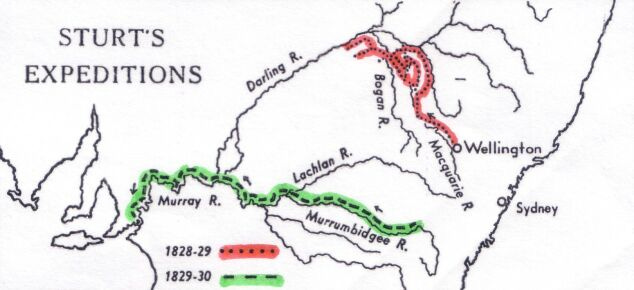
By Public domain map from Project Gutenberg Australia, [1] - follow the 'map' link for the explorer., Public Domain, https://commons.wikimedia.org/w/index.php?curid=2118313
Governor Darling approved another expedition in 1829 to try to solve this mystery by travelling down the Murrumbidgee River, sighted by the previous Hume and Hovell expedition. A whaleboat was built in sections, carried to the river and assembled, and they began their voyage down the Murrumbidgee on January 7, 1830.
Later that month they reached the meeting of the Murrumbidgee and a larger river, which Sturt named the Murray, not realising it was the same river Hume and Hovell had named the Hume.
Aboriginals were hostile, but Sturt was able to make peace with them.
They continued down the Murray, reaching its meeting with the Darling. Sturt had proved all the western-flowing rivers flowed into the Murray. In February, they reached the large Lake Alexandrina, and then the sea, finding the mouth of the Murray was a maze of lagoons and sandbars and impassible to shipping.
Then they had to row all the way back up the Murray and Murrumbidgee, against the summer heat, reaching modern Narrandera in April, where their supplied ran out and they had to halt, sending two men overland for help, which only just arrived in time to save them from starvation. Sturt went blind for several months and never fully recovered.
They had travelled nearly 2900 kilometres of the river system when they finally returned to Sydney.
Sturt had a break from exploring, briefly served as Commander on Norfolk Island, preventing a convict mutiny, went to England in 1832 on sick leave and published ‘Two Expeditions into the Interior of Southern Australia during the years 1828, 1829, 1830 and 1831.’
This book established his public reputation in England, but the government was slow to promote him. The book did interest Edward Gibbon Wakefield, who was to choose South Australia for a new settlement of free colonials, without any convicts.
Sturt eventually received a land grant of 2000 hectares, in exchange for giving up his pension rights, married Charlotte Christiana Greene, and returned to Australia to farm the property, which he named ‘Belconnen’, now a suburb of Canberra.
In 1838, Sturt led a team who herded cattle overland from Sydney to Adelaide, proving the Hume and Murray were the same river. Then he led an expedition to the mouth of Murray, settling the argument about where to found Adelaide.
Sturt returned to NSW to organise his affairs and then returned to settle at what is now Grange in South Australia in early 1839 where he was briefly Surveyor-General of South Australia and a member of the South Australian Legislative Council.
In September, 1839, Sturt and Charlotte accompanied the Governor of South Australia George Gawler, his daughter Julia, Henry Bryan and Henry Inman on a Murray River expedition, but Bryan became lost in a dust storm and his body was never recovered, although his horse did eventually return alone to Adelaide.
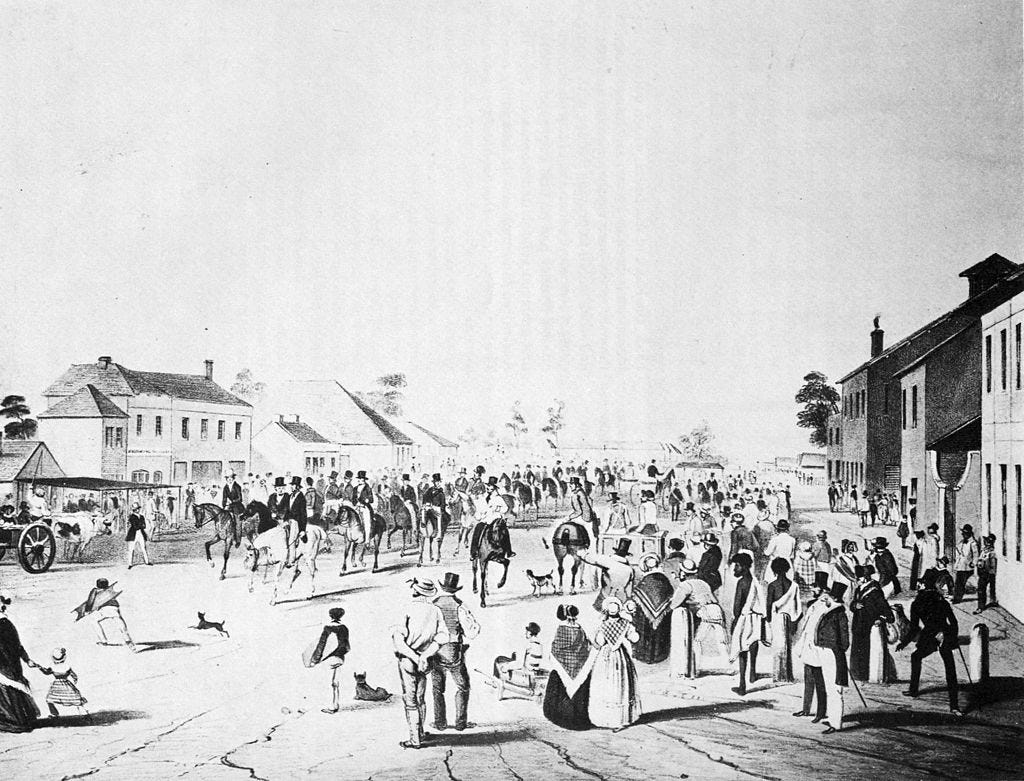
Sturt sets off. Drawing by S.T. Gill (died 1880 - so public domain) - Own work, Public Domain, https://commons.wikimedia.org/w/index.php?curid=392169
Sturt’s third and final expedition in search on the ‘great inland sea’ began in August 1844 with a party of 15 men, 200 sheep, six drays loaded with supplies and a boat. They left Adelaide amid great hopes they would find great inland pastures for the colony to expand into, rather than being blocked by the expanse of salt lakes previously found by Edward Eyre.
One of his party was John McDouall Stuart, who was in time to go much further than Sturt, all the way to the top of Australia, but that’s another story.
They moved slowly along the Murray and Darling Rivers, were guided past the current Broken Hill by Aboriginal guide Topar, and were stranded by lack of water in extreme summer heat at Depot Glen near Milparinka, before the rain came and they could move to a site Sturt named ‘Fort Grey’, which is now in the Sturt National Park.
Sturt, Stuart and a small group kept going through what is now called ‘Sturt’s Stony Desert’ into the Simpson Desert, but were forced to turn back to the depot. The ordeal is described in gripping detail in Rudolph’s “Sturt’s Desert Drama’.
During the six months they were trapped Sturt had an underground room dug in which they placed the ailing James Poole, whose legs had turned black from scurvy, leaving him unable to walk, and stored provisions in the coolness.
Sturt repeatedly scouted seeking waterholes, but found none.
“Nothing can exceed the dreadful nature of the country we traversed today, worse in truth than any we have entered,’ Sturt wrote in his journal.
Eventually, Sturt sat on a sandhill with a bleak view and admitted defeat.
‘After this, I believe I sat on the hill for more than half an hour with my telescope in my hand, but found nothing to encourage me onwards. I would willingly have laid my head on the desert, never to raise it again,’ Sturt wrote. 2
Sturt and doctor John Browne decided Poole would die unless he got better food, but they also feared he was so sick he could die if he was moved without adequate food and water. Either choice was likely to end in death.
Eventually rain did fall after six months and Sturt moved immediately to send Poole south on a dray, but he died anyway within a day, after the scurvy had caused him to lapse into deep depression and then a violent tirade against everyone around him. They returned his body to the depot for burial.
Sturt himself had his legs turn black and was unable to walk. Some waterholes held so little water the animals drank them dry overnight, forcing the party to keep moving despite their exhaustion.
Some of the horses died. The men killed a bullock, turned it inside out, discarding the entrails, sewed up the tail and filled the carcass with water, sewing the neck shut to make a giant water container carried on a dray.
Stuart and Browne took over leadership for a time from Sturt, who was so ill from scurvy that he could not walk and had to be carried on a wagon.
Stopping frequently to rest, they reached the reliable waters of the Darling River and finally straggled back into the settled areas in mid-January, 1846, after 17 months away, having travelled 4800 kilometres of the most arduous journey imaginable.
Sturt was taken home in a carriage by friends, arriving at midnight to open the door, supported by two others, to have his wife Charlotte faint from shock at his gaunt appearance,
The other haggard men staggered slowly back into Adelaide on January 28, 1846, with spectators starting to cheer, but then falling into shocked silence as they saw how emaciated were the survivors.
Sturt never fully recovered his eyesight. He went to England in 1847, receiving several honours, and prepared his ‘Narrative of an Expedition into Central Australia’, published in 1849.
He returned to Adelaide and was appointed Colonial Secretary, overseeing major work as the colony grew, but his poor eyesight resulted in him resigning in 1851, receiving a pension of 600 pounds a year, and he settled on 200 hectares at The Grange near Adelaide.
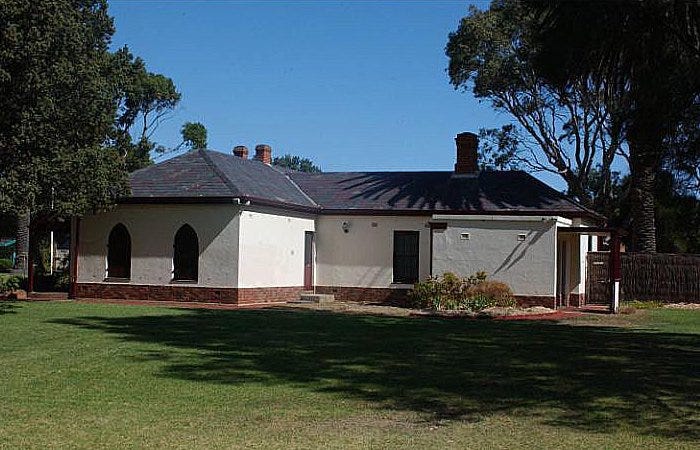
By JERRYE & ROY KLOTZ MD - Own work, CC BY-SA 3.0, https://commons.wikimedia.org/w/index.php?curid=24498629
In 1853 the family sailed for England and lived at Cheltenham. Sturt applied unsuccessfully for the positions of Governor of Victoria and Governor of Queensland. His three sons all served in the military.
He was recommended for a knighthood, but died before it could be approved, on June 16, 1869. Charlotte was granted a pension of 80 pounds a year and the title Lady Sturt.
Sturt was brave, careful, kind, treated the Aborigines well, had a genuine religious faith and was liked and respected by his men. He was probably not ruthless enough to be a great success in politics, but his other achievements were significant.
His legacy includes Sturt National Park, the City of Charles Sturt in Adelaide’s suburbs, Charles Sturt University, the Sturt River and the Sturt Highway from Wagga Wagga to Adelaide.
After reflection Sturt, a modest man, concluded that God, far from abandoning him to die in the desert, had actually intervened at key moments to save him and his party from certain disaster. He wrote:
‘It is to Providence, rather than my prudence, that we owe our final safety.’ 3
Sturt’s journal, quoted in Ivan Rudolph, ‘Sturt’s Desert Drama’, 2013, Boolarong Press, Salisbury, Brisbane, Australia, p. 266.
John Bailey, Mr Stuart’s Track, 2007, Pan Macmillan Australia, p. 31.
Rudolph, op. cit., p. 306.