
BRITAIN'S MULTICULTURAL OUTCASTS FOUND MODERN AUSTRALIA
Thrown out of Briton, they thrive on the convict continent.

https://digitalclassroom.nma.gov.au/sites/default/files/styles/two_column_bottom_cards_image_style/public/2023-03/1800s_BI_1833_ConvictTransportationPeaks-1200w.jpg?itok=echLRA4H
WHAT IS MICHAEL’S CURIOUS WORLD?
Australia’s history is the story of a fightback.
Britain’s elite decided the common people were too much trouble, with their annoying demands for freedom, a decent wage and food to eat - how dare they? So the elite exported their surplus people to the other side of the world to found a brutal penal colony where they were abused and flogged for daring to resist.
But something surprising happened - the little people did fight back and, bit by bit, they won. Australia still isn’t perfect, but it’s globally respected as one of the best true democracies on the planet, based on the ideal of ‘a fair go for all’.
How did that happen? Michael’s Curious World (MCW) is travelling the country and writing about it. Sure, there are some big people in this story, because they did important things, but MCW’s real focus in on the little people, the real Aussie battlers who got up every morning and made a difference.
To follow and support this fascinating story:
Click ‘Subscribe’, choose a free or paid option and enter your details to receive full access to regular posts and the growing archive of past posts. If you can help, it only costs a coffee a month to put fuel in my tank.
Click ‘Michael’s Curious World - Posts’ for a menu of the past posts.
Click ‘Like’ to tell the algorithm to spread the word.
Today we look at the big picture of convict transportation to Australia.
‘We left our country for our country’s good.’ - George Barrington
BRITON’s outcasts, about 164,000 convicts, founded modern Australia after being transported from Britain on 806 ships between 1788 and 1868.
The convicts were very multicultural. While 70% of convicts were English or Welsh, about 24% were Irish, five percent Scottish, and there were also people from India, Canada, Maori from New Zealand, Chinese from Hong Kong and slaves from the Caribbean.
At least six black Africans were among the convicts who arrived at Botany Bay on the First Fleet on January 21, 1788, after 252 days at sea, including ‘John Caesar’ (real name unknown) from Mauritius, who became Australia’s first bushranger.
About 25,000 women formed about 15% of the convicts, mostly young single women who had been domestic servants or had a semi-skilled background, including Mary Bryant who escaped by boat and returned to England. Britain deliberately sent young women of marriageable age to the convict continent to provide wives for ex-convicts and free settlers.
A Convict Maid
‘But in my youthful heart betrayed,
And now I am a Convict Maid.
To wed my lover I did try,
To take my master’s property,
So all my guilt was soon displayed,
And I became a Convict Maid.
Then I was soon to prison sent,
To wait in fear my punishment,
When at the bar I stood dismayed,
Since doomed to be a Convict Maid.’ - The London Convict Maid, a cautionary tale of life in the colony, circa 1830, nla.obj-1117449.
MARY BRYANT - TRAGIC STORY OF FIRST FEMALE CONVICT TO ESCAPE NSW

The story of Mary Bryant is one of the great, tragic, and mysterious tales of Australian maritime history.
Britain exports its surplus people
Some convicts were children as young as nine years. About 6000 convicts were Jewish. About 80% were transported for theft of food or clothing.
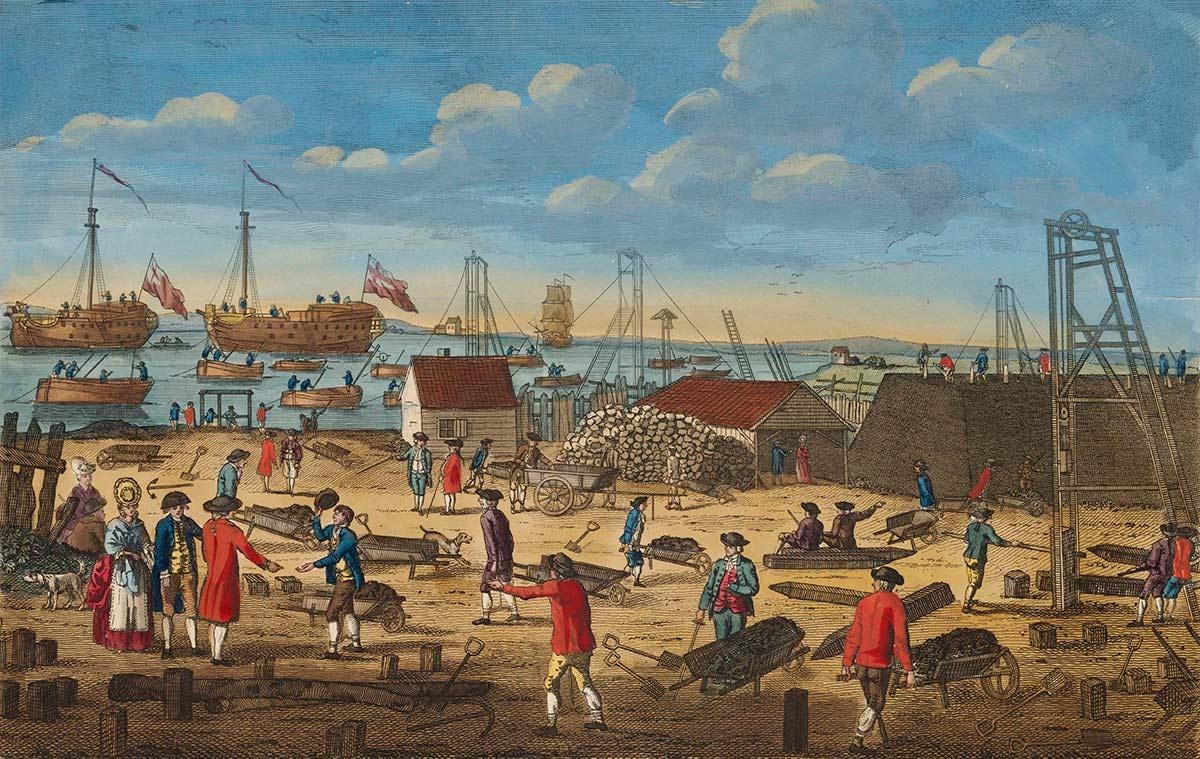
Many convicts were held on rotting prison hulks before being transferred to ships for the voyage to Australia. About 2000 convicts died during the long voyages over 80 years, sometimes in awful conditions of neglect on ships hired by the British Government which had previously carried slaves from Africa.
Britain had used transportation as a punishment since the early 1600s and passed The Transportation Act 1717, with penalties of seven or 14 years transportation.
Industrialising cities were growing fast with machines replacing workers, who struggled to find work and stole food and clothing to survive in poverty and child labour, as described in the novels of Charles Dickens.
British society imposed harsh punishments for trivial crimes, with 222 crimes carrying the death penalty by the 1770s, including absurdly harsh examples such as theft of goods worth over five shillings, cutting down a tree and theft of an animal. Ironically, prostitution was not a transportable offence.
There was a misguided belief that harsh penalties encouraged people to reform, when the real cause of their thieving was mostly poverty. Juries sometimes refused to convict if the penalty was death. Transportation became seen by magistrates and lawmakers as a more humane alternative to execution.
More than 60,000 people had been transported to America by 1775, but the American colonies won independence and ceased to accept convicts from 1783. By 1788, British prisons were increasingly overcrowded and prisoners were being kept in squalid hulks, so the British authorities needed a new outlet.
Phillip founds New South Wales
James Matra, an American who had been a junior officer on Captain James Cook’s 1768 Endeavour voyage to the Pacific and was a friend of botanist Joseph Banks, suggested in 1783 that Botany Bay was a good place for a new colony, with agricultural and strategic benefits. After also considering a site in Africa, the British Government adopted Botany Bay in 1786.
Commodore Arthur Phillip was put in charge of leading a fleet of ships to found a new colony for convicts at Botany Bay. Six transport vessels in the fleet of 11 ships (which also included two naval escorts and three storeships) carried 775 convicts, including 193 women, 252 crew and officials, and a combined total of 645 children of convicts, soldiers and officials.
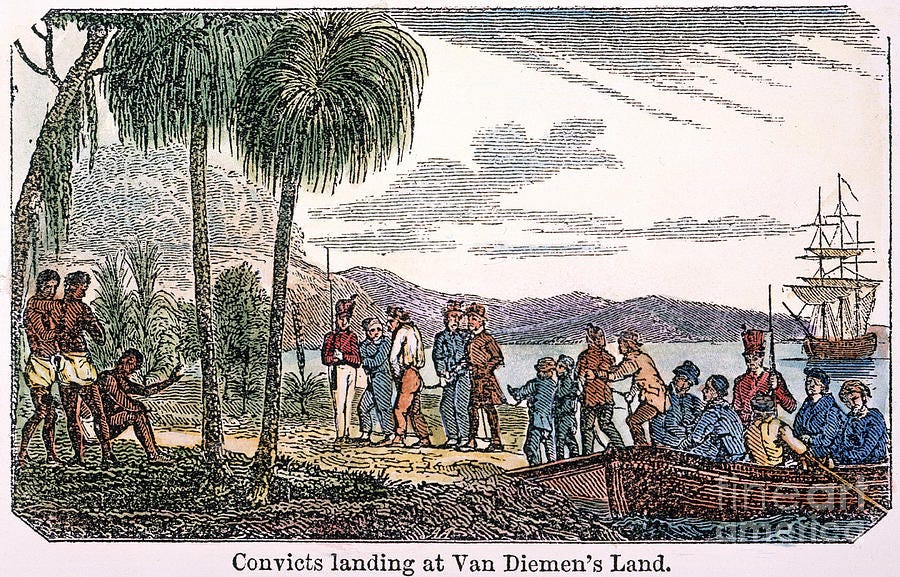
They sailed from Portsmouth in May, 1787, and progressively arrived in Botany Bay in January, 1788, but Phillip decided the bay was too shallow, unprotected and lacked fresh water, and moved the colony north to Sydney Cove, which he described as ‘one of the finest harbours in the world’.
‘The laws of this country will of course be introduced in New South Wales, and there is one that I would wish to take place from the moment His Majesty’s forces take possession of the country: That there can be no slavery in a free land, and so consequently no slaves.’ - Governor Arthur Phillip.
PHILLIP LEADS A GREAT MIGRATION FLEET

Captain Arthur Phillip, 1786, by Francis Wheatley, oil painting, State Library of New South Wales ML 124. By Francis Wheatley - State Library of New South Wales ML 124, Public Domain, https://commons.wikimedia.org/w/index.php?curid=158294687
A dangerous journey
The death rate was low on Governor Phillip’s First Fleet with surgeon John White’s official report documenting 48 deaths, including soldiers and crew, 28 births and 30 landing sick. The number of people in the First Fleet is disputed because the number of crew on some ships is unclear.
The last surviving convict from the First Fleet is believed to have been 89-year-old Elizabeth (Betty) Thackery (1767 – August 7, 1856) from New Norfolk in Tasmania. She is believed to have been the first female convict to actually step ashore at The Rocks in Sydney in January, 1788, followed by other convict girls who were cheered by the males as they ran up the beach.
Betty had been sentenced to seven years transportation for stealing five handkerchiefs with a total value of one shilling. She later moved to Tasmania and in 1810 married Samuel King, a marine private who is believed to have been the last surviving male from the First Fleet.
However, the six ships in the Second Fleet in 1789 became notorious for poor conditions and mistreatment of convicts. Of the 1038 convicts embarked, 273 died during the voyage and 486 were sick on landing in 1789, with 124 of the sick dying shortly after coming ashore.
Half-naked convicts lay without bedding on the ships, covered in lice, and too ill to move. Rev. Samuel Johnson wrote, ‘They were wretched, naked, filthy, dirty, lousy and many of them utterly unable to stand, to creep, or even to stir hand or foot.’
Guard Commander Captain William Hill accused the ships’ masters of withholding food from ‘the unhappy wretches’ to sell in port and of pocketing the British Government’s allowances for the convicts. Particular blame was levelled on Donald Trail, master of The Neptune, but no master was prosecuted.
Conditions were better on the 11 ships of the third fleet in 1791, with only 182 deaths from 1885 convicts who arrived at Port Jackson.
Some convicts become successful
Governor Phillip introduced a system of convicts being employed based on their skills. While some convicts had terrible lives in grim penal colonies such as the infamous Port Arthur in Tasmania, there were also success stories.
Samuel Terry proved to be a sharp businessman and rose from being a penniless stonemason to be the richest man in Sydney. Francis Greenway, who had been sentenced to death for forgery in England, went on to design many of the most important historical buildings in Sydney, including Hyde Park Barracks. D’Arcy Wentworth escaped four charges of highway robbery and fled to Sydney.
Many former convicts joined the increasing number of free settlers to oppose transportation and support self-government to, as Australian-born bushranger Ned Kelly said, ‘throw off the yoke of British oppression’.
Particularly troublesome were the Irish convicts, including the leaders of the Irish rebellion, as well as the unionist Tolpuddle Martyrs, anti-industrial Luddites, Canadian rebels and reforming Chartists.
About 3600 convicts were political prisoners, mainly from Ireland and Scotland. They became the leaders of the Irish revolt in Sydney in 1804 and of ‘The Battle of Castle Hill’.

Life as a convict
Convicts went to New South Wales from 1788-1840, Norfolk Island from 1788-1808, Van Dieman’s Land (Tasmania) from 1803-1853, Moreton Bay (Brisbane) in Queensland from 1824-1839 and Western Australia from 1850-1868,
Many were assigned to work for free settlers who began arriving from 1793 or on government projects such as buildings, shipbuilding and roads. Some were pardoned for good behaviour while others completed their sentences and received tickets-of-leave, often becoming free settlers themselves.
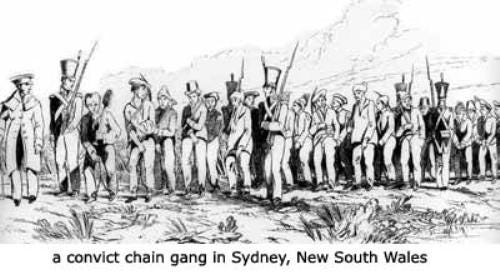
They worked from sunrise to sunset, Monday to Saturday every week, lived under strict rules and punishments included whippings, being forced to wear leg-irons and solitary confinement. Repeat serious offenders could be sent to hard labour prisons.
Lieutenant-Governor Sir Richard Bourke (1831–1837) was appalled by brutal punishments imposed by magistrates and limited floggings to 50 lashes, restricted the number of convicts assigned to settlers to 70 and allowed ex-convicts to buy property and serve on juries. Governor Lachlan Macquarie (1810-1821) even appointed some ex-convicts to government positions. The reforms encouraged the push to end transportation.
Transportation peaked in 1833 when nearly 7000 convicts arrived. Only six percent of convicts were locked up, with most working. Some were given permission to earn their own living while still convicts. Once they received a Certificate of Freedom they could own land.
Transportation ends
https://factfile.org/wp-content/uploads/2016/03/Australian-Convicts.jpg
Opposition to penal transportation increased in the east. Convicts were blamed for causing crime and vice, seen as unfair competition with free workers and regarded as a ‘hated stain’ on the population. The campaign eventually succeeded and transportation to NSW ceased on May 22, 1840 and to Tasmania in 1853.
Western Australia initially did not have directly transported convicts, although 23 were sent from New South Wales to work at the settlement founded at King George Sound (Albany) in 1826 until 1831.
In 1849, Western Australia became self-governing and applied to Britain for convicts to work on essential projects, including the road from Albany to Perth, the Fremantle bridge, Government House and the Fremantle Prison.
This system continued until the last 279 of 9668 convicts arrived at Fremantle on the Hougoumont on January 10, 1868.
Samuel Speed was believed to be the last surviving convict transported to Australia when he died at Perth in 1938. Born in Birmingham in 1841, the homeless Speed was convicted of setting fire to a haystack, which he did to be arrested and get fed in gaol. He was transported to Western Australia in 1866, gained his freedom five years later and worked on bridge construction until he retired.
https://images.fineartamerica.com/images-medium-large/australia-convicts-1804-granger.jpg
Convict legacy
Over four million Australians can trace their links back to convicts. While having a convict heritage was once seen by some as shameful, over time people have become increasingly proud of being descended from the founders of modern Australia.
UNESCO has placed 11 Australian convict sites on its World Heritage List: Norfolk Island; Old Government House, Parramatta; Hyde Park Barracks, Sydney; Brickendon and Woolmer Estates, Tasmania; Darlington Probation Station, Tasmania; Old Great North Road near Sydney; Cascades Female Factory, Tasmania; Port Arthur, Tasmania; Coal Mines Historic Site, Tasmania; Cockatoo Island, Sydney; Fremantle Prison, Western Australia.
Fiction about convicts includes the popular ballad, ‘Botany Bay’. Novels include, ‘For the Term Of His Natural Life’ by Marcus Clarke, ‘Moondyne’ by John Boyle O’Reilly, ‘The Broad Arrow’ by Caroline Woolmer Leakey, ‘Bring Larks and Heroes’ and ‘The Playmaker’ by Thomas Keneally, ‘A fringe of Leaves’ by Patrick White, ‘The Potato Factory’ by Bryce Courtenay, ‘Gould’s Book of Fish’ by Richard Flanagan and ‘The Secret River’ by Kate Grenville.
Convict George Barrington wrote a play which was performed at Port Jackson in 1789 and is now known as ‘Our Country’s Good’ which includes the ironic lines:
‘From distant climes, o’er wide-spread seas, we come,
Though not with much eclat or beat of drum,
True patriots all: for, be it understood;
We left our country for our country’s good.’
More information:
Searchable records of 155,000 convicts are at Convict Records: convictrecords.com.au
The National Library of Australia has a Convict Research Guide at library.gov.au with useful information for people tracing their ancestry.
Discussion
How accurate is it for people to say Australia has always been a monoculture?
Why did Britain use harsh laws to transport so many people from many cultures to Australia and other colonies?
Why was the voyage of the First Fleet under Governor Arthur Phillip regarded as a big success, compared with later voyages?
Why did former convicts who had been freed become supporters of the end of transportation and self-government?
How has the history of convict transportation shaped attitudes in modern Australia?
Yes but bogans forgot about that
So people, at the suggestion of my reader Ray Budge, I've added discussion questions at the end of this report, and future reports.
So folk, how has convict transportation affected the development of Australian society and attitudes?
Are we different because of our convict background?
For example, is it our convict background which makes us sceptical of authority and quick to tear down tall poppies?
What do you think? Love to hear from you.